


The Avinox M2S is an incredibly powerful motor, but that is only part of what makes it impressive. Having ridden it in the Amflow PX Carbon Pro, what stands out most is how quickly and smoothly it delivers its assistance. There is a strong, surging push when you ask for it, without the abrupt hit that can leave you fighting for rear-wheel grip.
This Avinox M2S motor review draws on that Amflow test bike and its 700Wh battery. It covers the response, modes, noise and battery use I experienced on the trail. For the handling, suspension and brakes, read my Amflow PX Carbon Pro review.
The test bike: Amflow PX Carbon Pro
Amflow PX Carbon Pro
Smooth, immediate Avinox assistance, superb front-end grip and confident cornering, with rear-suspension limits and a softer brake feel than we would like.


+ Pros
- Smooth, progressive power with quick pickup on climbs
- Excellent Fox 36 Factory fork and cornering grip
- High-end suspension and SRAM X0 specification
− Cons
- Soft brake lever feel and muted initial bite
- Rear suspension reaches its limits before longer-travel rivals
- Frequent Turbo use draws down the battery quickly
- Busy handlebar controls
Compare prices
PX Carbon Pro — Moonstone Grey, Avinox M2S, 700Wh
Prices and availability may change. Prices are checked when this guide is updated. Confirm the current price and availability with the retailer.
Our verdict
An impressive trail eMTB whose power delivery is as useful as its headline output. The Fox 36 Factory fork and cornering grip stand out, but riders prioritising repeated hard impacts should consider a longer-travel bike. Trail mode provided enough assistance for most of our riding.
Key specifications
- Motor
- Avinox M2S
- Battery
- 700Wh integrated
- Fork
- Fox 36 Factory GRIP X2, 160mm
- Rear suspension
- Fox Float X Factory, 150mm wheel travel
- Drivetrain
- SRAM X0 Eagle Transmission
- Brakes
- Magura Gustav Pro
- Wheels
- Amflow XMC-30 carbon, 29in front / 27.5in rear
- UK RRP
- £8,999
Avinox M2S motor: the key figures
Avinox quotes up to 130Nm in regular assistance modes and 150Nm in Boost, with a rated output of 250W. Peak output depends on the battery: the M2S can deliver a claimed 1500W with the FP700 battery used by the Amflow PX, while FS600 and FS800 combinations are rated for 1300W peak. These are manufacturer figures, not measurements from my test.
That battery distinction matters when comparing complete bikes. An M2S badge does not mean every installation has identical maximum output. However, the numbers tell you little about the part I enjoyed most: how usable the assistance feels.

Testing: immediate assistance without the kick
On an incline, the M2S picks up almost immediately. I never felt as though I was waiting for the motor to catch up as the gradient steepened. Crucially, that response does not arrive as a kick through the back wheel. It builds in a controlled wave, giving the bike a progressive push.
There is no mistaking how much power is available. Yet it feels manageable rather than something I have to work around. Quick response and smooth delivery can sound contradictory on paper, but the M2S combines them particularly well.
The benefit is especially noticeable over boulders. When rocking the pedals and pumping the bike through a rocky section, I could feel the assistance helping that movement. It supported what I was trying to do instead of delivering an unwanted boost at an awkward moment, something I have experienced with other motors.
The Amflow’s tyres, suspension and geometry also contribute to its grip. I would not give the motor sole credit for the bike’s climbing ability, but its delivery makes that capability easier to use.

Trail is plenty; Auto is the standout mode
There is a clear step in assistance between the different modes. They feel meaningfully different, rather than a collection of settings with barely noticeable changes.
Trail gave me more than enough help for most riding. Turbo felt necessary only for the most demanding, steep sections. There is huge appeal in having that extra assistance available, but I rarely felt I needed it as the default.
Auto was exceptionally good. Its delivery worked smoothly across the range, responding as the effort changed without leaving me waiting. It let me concentrate on the trail rather than repeatedly deciding whether to move up or down a mode.
I also liked the audible beep when changing modes. It is a useful confirmation while riding. The collection of gear and display controls around the Amflow’s bars felt less intuitive, though; there are quite a few buttons competing for attention.

Noise and battery use
The motor is audible, but I did not find its noise excessive. To my ears, it was no more noticeable than the Specialized 3.1 and quieter than the Giant SyncDrive I had recently tested. That is a riding impression, not a controlled sound-level comparison; the complete bike and conditions can affect what you hear.
Battery consumption was the bigger reservation. The higher assistance modes drained the Amflow’s 700Wh battery faster than I expected, particularly when leaning on Turbo. The performance is impressive, but using a lot of it has an obvious cost.
I would not turn that observation into a fixed range claim or a verdict on the motor’s efficiency. Terrain, rider input and the bike itself all matter. My practical takeaway is to use Trail or Auto for normal riding and save Turbo for the sections that need it. Our guide to choosing an 800Wh eMTB battery explains the capacity trade-offs.
Other bikes with the Avinox M2S
The Amflow is the bike tested here. These two alternatives use the M2S too, but the comparisons below are based on published specifications, not riding tests. Both pair it with an 800Wh battery and advertise 1300W peak output. Check your size and delivery date: availability varies between dealers.
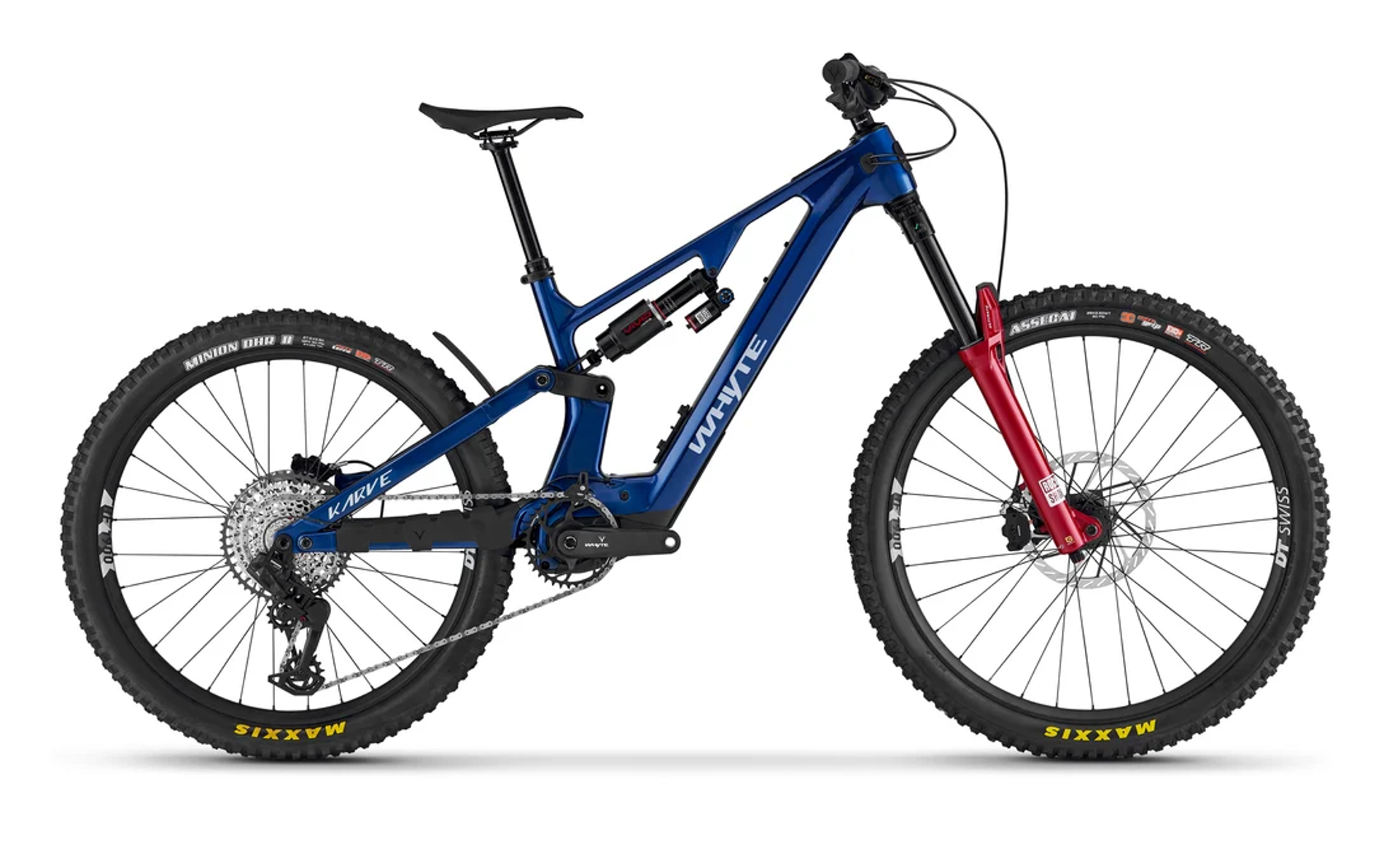
Whyte Karve EVO RSX
An M2S-powered alternative for gravity riding, with 180mm travel at both ends and an 800Wh battery.
At Leisure Lakes Bikes
Karve EVO RSX; 800Wh; 180mm travel
+ Pros
- Avinox M2S motor
- 180mm front and rear travel
- 800Wh battery and 12A charger
− Cons
- Battery is fixed for everyday use
- More bike than many trail riders need
Compare prices
Karve EVO RSX; 800Wh; 180mm travel
Prices and availability may change. Prices last checked: 2026-10-23 07:40 UTC. Prices are checked when this guide is updated. Confirm the current price and availability with the retailer.
Why it makes the shortlist
The Whyte Karve EVO RSX is the long-travel choice for riders whose days revolve around steep descents, rough enduro trails and repeated bike-park laps. Its 180mm travel at both ends gives it a different purpose from the shorter-travel trail bikes here: choose it for demanding terrain, rather than simply because its motor has a high output.
The build puts useful money into the suspension and brakes. A RockShox ZEB Ultimate fork and Vivid Ultimate rear shock offer extensive adjustment, while SRAM Maven Silver brakes use a 220mm front rotor. The Maxxis front and rear tyre combination and DT Swiss wheels are appropriate for a bike designed to be ridden hard. Setting the suspension and tyre pressures to the rider remains essential.
Avinox M2S assistance and an 800Wh battery make the Karve attractive for climbing back to the top under its own power. The included 12A charger is another practical feature between rides. However, the battery is fixed for everyday use: removal for maintenance requires motor removal, so this is a poor match for anyone who must regularly charge a battery away from the bike.
The carbon mainframe and alloy rear end use mixed wheels, with a geometry adjustment link to tune clearance and descending stance. This is a researched recommendation based on the current build and verified retailer offers, not a claim that we have completed a hands-on test of this exact RSX. Arrange a demonstration if you are deciding between this gravity-focused bike and a more versatile 150mm trail model.
Key specifications
- Frame
- Carbon mainframe, alloy rear triangle, adjustable geometry
- Motor
- Avinox M2S; 150Nm maximum, 1300W peak, 250W nominal (listed specification)
- Battery
- Avinox 800Wh; fixed for daily use; 12A charger
- Fork
- RockShox ZEB Ultimate Charger 3.2, 180mm
- Shock
- RockShox Vivid Ultimate RC2T; 180mm rear travel
- Wheels
- DT Swiss Hybrid HF1900; 29in front / 27.5in rear
- Tyres
- Maxxis Assegai front, Minion DHR II DoubleDown rear
- Drivetrain
- SRAM S1000 AXS Eagle 12-speed, 10–52T
- Brakes
- SRAM Maven Silver; 220mm front / 200mm rear rotors
Whyte lists the Karve EVO RSX at £7,299 through its dealers. Its 180mm travel makes it the gravity-focused option here.
Mondraker Zendit RR
A carbon M2S-powered alternative with mixed wheels, 165mm rear travel and an 800Wh battery.

At Leisure Lakes Bikes
Zendit RR, 800Wh; confirm size and colour availability
+ Pros
- Avinox M2S motor
- 800Wh battery
- 170mm fork and 165mm rear travel
− Cons
- Availability varies by size and retailer
- 1300W advertised peak rather than the Amflow combination’s 1500W
Compare prices
Zendit RR, 800Wh; confirm size and colour availability
Prices and availability may change. Prices last checked: 2026-10-15 10:00 UTC. Prices are checked when this guide is updated. Confirm the current price and availability with the retailer.
Why it makes the shortlist
A specification-based option for riders who want M2S assistance in a longer-travel carbon bike. The 800Wh battery offers more capacity than the test Amflow, but this is not a measured range comparison. UK listings include stock and pre-orders, so check the exact variant before buying.
Key specifications
- Motor
- Avinox M2S
- Peak output (manufacturer)
- 1300W
- Battery
- 800Wh
- Travel
- 170mm front / 165mm rear
- Wheels
- 29in front / 27.5in rear
- Frame
- Carbon
- UK RRP
- £7,399
The £7,399 Mondraker Zendit RR pairs a 170mm fork with 165mm rear travel. For a wider shortlist, see our Avinox eMTB buying guide.
Avinox M2S review: verdict
The M2S impresses me most when the trail gets awkward. Its prompt, progressive assistance helps me work the bike over obstacles without feeling as though the motor is taking over. Trail has ample support, while Auto makes excellent use of the available power.
Heavy use of the higher modes demands attention to battery capacity, and the motor is not silent. Even so, this is a remarkably capable system. The headline power gets your attention; the control is what makes it worth riding.
Do you need Turbo on the Avinox M2S?
For most of my riding, no. Trail provided plenty of assistance and Auto adapted very well. Turbo was most useful on the sharpest, steepest climbs.
Does every Avinox M2S bike have 1500W?
No. Maximum output depends on the battery pairing. Compare the exact bike specification, rather than assuming every M2S-equipped model matches the test Amflow.