


The best tubeless sealant for eMTB riding is the one that suits your tyres, puncture risks and maintenance routine. A liquid that is easy to inject can make regular top-ups simple; a formula with more fibres or crystals can bring different installation requirements. Neither approach removes the need for the right casing, a sound tubeless rim and enough liquid inside the tyre.
Muc-Off’s No Puncture Hassle MTB sealant is our overall starting point for its useful pouch, clear dosage guidance and practical features. Peaty’s Holeshot is particularly appealing for frequent workshop use, while Stan’s Race Day asks for more attention in return for a specialised sealing formula. The bottle sizes below range from small top-ups to one-litre supplies, so compare cost per 100ml as well as the price at the checkout.
Start with the tyre itself. Our eMTB trail tyre guide explains the different casings and compounds, while our mud tyre guide covers softer ground. If a casing is regularly being cut or folded, changing sealant alone is unlikely to solve the problem.
The best tubeless sealant for eMTB shortlisted
Overall choice: Muc-Off No Puncture Hassle MTB Sealant — 140ml — £7.50
milKit Tyre Sealant — 75ml — £3.15 (RRP £7.50)
Continental RevoSealant — 240ml — £9.50 (RRP £13.50)
Orange Seal Regular with Injector — 8oz — £9.99
Orange Seal Endurance with Injector — 8oz — £10.99
Finish Line FiberLink Tubeless Sealant — 240ml — £11 (RRP £15)
Peaty’s Holeshot BioFibre Sealant — 1L — £20 (RRP £30)
Effetto Mariposa Caffélatex — 1L — £27 (RRP £28)
Stan’s Original Tubeless Sealant — 1L — £32 (RRP £36)
Stan’s Race Day Tubeless Sealant — 1L — £46
The best tubeless sealant for eMTB in detail

Muc-Off No Puncture Hassle MTB Sealant — 140ml
Best all-round choice
£7.50
Muc-Off’s MTB sealant is our overall starting point for riders who want a straightforward installation and a useful balance of features. The 140ml pouch can feed through a compatible Presta valve once its core is removed, making it practical for a fresh fill or a trail-bag spare. The formula includes UV dye to help locate leaks, and Muc-Off states that it is CO₂ compatible.
The pouch size is relevant to a large tyre: Muc-Off recommends 105–140ml for a 29in MTB tyre, rather than expecting one small bottle to fill both wheels. It is a convenient way to start, although regular users can reduce the cost and packaging per fill by choosing a larger bottle. The best tubeless sealant for eMTB riding still needs enough liquid in the tyre to work, so check the level rather than relying on how long the bike has held pressure.
Pros
Valve-friendly pouch
UV dye helps locate leaks
Stated CO₂ compatibility
Cons
Small pouch costs more per fill than a workshop bottle
Specifications
Bottle size: 140ml
Cost per 100ml: £5.36
Formula: latex-based with sealing particles
Claimed puncture size: up to 6mm
29in MTB dosage: 105–140ml per tyre
Shake thoroughly before use

milKit Tyre Sealant — 75ml
Compact top-ups for an existing milKit setup
£3.15 (RRP £7.50)
The small milKit bottle makes most sense as a measured top-up or a compact spare for a setup already using the same sealant. Its homogeneous formula is designed to keep the sealing material evenly distributed instead of leaving the useful particles at the bottom of a bottle. That can help make small top-ups consistent, while the ammonia-free formulation avoids a corrosive ingredient found in some sealants.
At 75ml, this is not a workshop supply and should not be treated as enough for two large eMTB tyres. Consult milKit’s dose guidance for your tyre and account for liquid already inside it. The separate milKit valve and syringe system offers another route to checking and replenishing sealant, but those parts are not included here. Choose the small bottle for portability; choose a larger supply if you are regularly changing tyres or maintaining several bikes.
Pros
Compact bottle for a ride bag
Homogeneous formula
Ammonia-free
Cons
75ml is a top-up-sized supply for a large eMTB tyre
Specifications
Bottle size: 75ml
Cost per 100ml: £4.20
Formula: homogeneous liquid and sealing particles
Injection system: sold separately

Continental RevoSealant — 240ml
A straightforward match for Continental tyres
£9.50 (RRP £13.50)
RevoSealant gives riders using compatible Continental tyres a clear starting point. It is specifically optimised for the brand’s bicycle tyres, with an ammonium- and protein-free formulation intended to seal small punctures and cuts without chemically attacking the tyre or tube. The 240ml bottle is a manageable size for a home installation without committing to a large workshop container.
The attraction is compatibility and a simple maintenance routine rather than a race-formula claim. Follow Continental’s instructions for the tyre and rim, and inspect all tubeless components before fitting them. Sealant will not compensate for damaged tape, an unsuitable rim or a cut casing. For riders comparing the best tubeless sealant for eMTB use after fitting Kryptotal or Argotal tyres, RevoSealant is a sensible option to include in that decision.
Pros
Optimised for Continental bicycle tyres
Ammonium- and protein-free
Useful 240ml home-workshop size
Cons
A small-puncture solution, not a repair for structural tyre damage
Specifications
Bottle size: 240ml
Cost per 100ml: £3.96
Use: compatible tubeless-ready tyres
Designed for punctures and small cuts
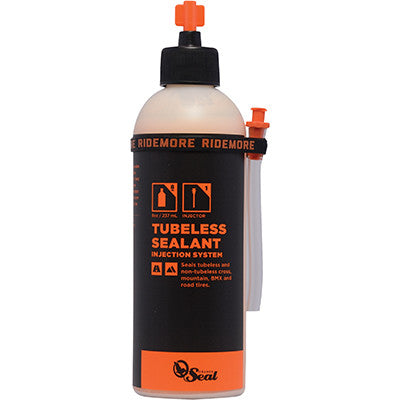
Orange Seal Regular with Injector — 8oz
A sealing-focused option for rough trails
£9.99
Orange Seal Regular puts the emphasis on sealing performance, while the Endurance version below is aimed at extending the interval between top-ups. The 8oz bottle includes an injector, making it convenient for adding sealant through a suitable valve. It is a useful option for riders who regularly encounter thorn holes and small trail punctures and are happy to check their tyres frequently.
Regular needs an active maintenance routine: the UK product guidance gives an average 30–45 days between top-ups, with actual life depending on the tyre and conditions. That is a meaningful trade-off against a longevity-focused formula. The best tubeless sealant for eMTB riders who prioritise sealing is not necessarily the one that asks for the least attention. Keep a plug kit and a way to reinflate the tyre with you, because larger damage can still exceed what a liquid sealant can handle.
Pros
Sealing-focused Regular formula
Injector included
Useful for porous sidewalls and small punctures
Cons
Needs more frequent checks than longevity-focused alternatives
Specifications
Bottle size: 236ml
Cost per 100ml: £8.47
Formula: Orange Seal Regular
Included: injector
UK guidance: average 30–45 days between top-ups
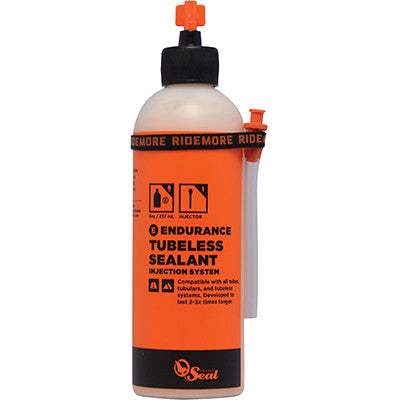
Orange Seal Endurance with Injector — 8oz
Longer intervals between top-ups
£10.99
Orange Seal Endurance is designed to remain useful inside the tyre for longer than the Regular formula. That gives it a clear role for riders who use their eMTB frequently but do not want tyre maintenance to become a constant job. This 8oz bottle includes an injector, so you can make measured additions through a compatible valve rather than opening the bead for every top-up.
Longer service life is still conditional on the tyre, climate and amount of liquid remaining. The UK guidance gives an average 60–120 days between top-ups, which should be treated as a starting point for inspections rather than a promise. A dry tyre needs attention whatever the calendar says. Endurance makes particular sense for mixed trails and regular riding; those choosing a sealant primarily for the most demanding punctures should also compare the more sealing-focused alternatives.
Pros
Longevity-focused formula
Injector included
Useful for regular mixed-terrain riding
Cons
Still requires checks; longer service life is not maintenance-free
Specifications
Bottle size: 236ml
Cost per 100ml: £9.32
Formula: Orange Seal Endurance
Included: injector
UK guidance: average 60–120 days between top-ups

Finish Line FiberLink Tubeless Sealant — 240ml
Fibre reinforcement in a low-viscosity formula
£11 (RRP £15)
FiberLink combines fast-acting natural latex with Kevlar fibres. The latex forms the seal while the fibres reinforce it, giving this product a different emphasis from a simple liquid-only formulation. Its low viscosity is intended to let the sealant move readily within the tyre, and the 240ml bottle is a practical quantity for riders who want to try it without buying a litre.
Use FiberLink’s own instructions when deciding how much to add and how to service the setup. The presence of fibres does not make a torn sidewall safe, and the formula should not be confused with Finish Line’s older tubeless products. Its useful role is a reinforced seal without choosing the installation restrictions of a very particle-heavy race sealant. As with the other options, inspect the tyre after a puncture rather than assuming a temporary seal is the end of the repair.
Pros
Natural latex reinforced with Kevlar fibres
Low-viscosity formula
Manageable 240ml bottle
Cons
No substitute for repairing a damaged casing
Specifications
Bottle size: 240ml
Cost per 100ml: £5.00
Formula: natural latex with Kevlar fibres
Low-odour formulation
Follow FiberLink-specific dosage and care instructions

Peaty’s Holeshot BioFibre Sealant — 1L
Good-value workshop supply for frequent tyre changes
£20 (RRP £30)
Peaty’s Holeshot is an appealing workshop option when you regularly swap tyres or maintain more than one bike. The one-litre bottle keeps the cost per fill low, while the formula combines fast-acting latex with biodegradable fibres and sealing particles. Peaty’s says those ingredients work together to bridge punctures up to 6mm, and the sealant can also help with the small leaks that appear during an initial tubeless installation.
The litre bottle is more useful on a workshop shelf than in a riding pack. Measure the amount needed for your tyre, keep the remaining supply properly closed and follow the product’s instructions when topping up. Fibre-rich sealant still needs a clean valve and periodic inspection. For riders weighing the best tubeless sealant for eMTB maintenance against the cost of frequent refills, Holeshot offers a strong balance of quantity, sealing ingredients and everyday practicality.
Pros
Low cost per 100ml in the one-litre bottle
Latex, fibre and particle formulation
Ammonia-free
Cons
Large bottle is less convenient to carry on a ride
Specifications
Bottle size: 1000ml
Cost per 100ml: £2.00
Formula: latex with biodegradable fibres and particles
Claimed puncture size: up to 6mm
Stated life: up to six months in temperate conditions, subject to checks

Effetto Mariposa Caffélatex — 1L
Foaming coverage for porous tyre casings
£27 (RRP £28)
Caffélatex takes a distinctive approach to distributing sealant. Its Actifoam ingredient turns the liquid into foam as the wheel moves, helping it spread around the inside of the tyre rather than simply collecting at the bottom. That makes it an interesting option for riders dealing with small sidewall leaks or a casing that needs thorough internal coverage during setup.
The formula is ammonia-free and is supplied here in a one-litre bottle. Effetto Mariposa gives a claimed sealing limit of up to 5mm for MTB use, but the shape of a hole and the condition of the casing still matter. It is a useful choice for riders who maintain their tyres methodically, rather than treating sealant as a way to avoid inspection. Check the liquid level regularly and use the brand’s tyre-volume guidance when filling a large eMTB tyre.
Pros
Foaming action distributes sealant around the casing
Ammonia-free
One-litre workshop bottle
Cons
Requires periodic liquid-level checks
Specifications
Bottle size: 1000ml
Cost per 100ml: £2.70
Formula: Actifoam foaming sealant
Claimed puncture size: up to 5mm for MTB
Operating range: −20°C to +50°C

Stan’s Original Tubeless Sealant — 1L
Simple valve injection for everyday use
£32 (RRP £36)
Stan’s Original remains a straightforward choice for riders who want an established all-round formula and uncomplicated top-ups. It can be installed through a compatible valve using a sealant injector, and the one-litre bottle is useful when maintaining several tyres. The brand describes a typical liquid life of two to seven months, while noting that dry conditions can require more frequent checks.
Its advantage over Race Day is convenience as much as price. There is no need to open the bead solely because of the formula’s particle size, and the service routine is less demanding. That suits trail-centre laps, mixed woodland riding and bikes used throughout the week. The best tubeless sealant for eMTB use should fit the way you look after the bike; Original is a sensible option when easy inspection and replenishment matter more than choosing the most specialised race product.
Pros
Compatible with valve injection
Useful one-litre supply
Straightforward all-round formula
Cons
Still needs inspection, especially in dry conditions
Specifications
Bottle size: 1000ml
Cost per 100ml: £3.20
Formula: Stan’s Original
Installation: compatible valve injector or directly into tyre
Stated liquid life: 2–7 months, condition dependent

Stan’s Race Day Tubeless Sealant — 1L
A more intensive approach to demanding rides
£46
Race Day increases the amount of sealing material compared with Stan’s Original and adds larger crystals. The aim is to deal with more demanding punctures during racing or a long event, where keeping the tyre inflated can matter more than making the next workshop visit convenient. It is a focused option for riders who accept additional maintenance in return for that sealing emphasis.
The installation rule is firm: pour Race Day directly into the tyre over the bead, because it cannot be installed through the valve. Stan’s also recommends visually checking the liquid every two to three weeks. Those requirements make it a poor choice for someone hoping to fit sealant and forget it. For riders comparing the best tubeless sealant for eMTB racing, however, the trade-off is clear and practical rather than hidden behind a headline puncture-size claim.
Pros
Extra sealing material and larger crystals
Designed for demanding events
One-litre bottle
Cons
Cannot be injected through the valve
Visual checks recommended every 2–3 weeks
Specifications
Bottle size: 1000ml
Cost per 100ml: £4.60
Formula: Stan’s Race Day
Installation: pour directly over the bead
Inspection: visually every 2–3 weeks
How to choose the best tubeless sealant for eMTB riding
Check compatibility first. The tyre and rim must both be suitable for tubeless use, and the sealant should be approved for the materials involved. A tyre insert can add another requirement, so consult its instructions as well. Avoid mixing different formulas unless the manufacturers explicitly permit it: their liquids and sealing ingredients may not behave as intended when combined.
Then decide how much workshop attention you are prepared to give the system. A valve-injectable formula makes routine additions convenient. A race formula that must be poured over the bead needs a different routine and may call for more frequent visual checks. The best tubeless sealant for eMTB ownership is not automatically the one with the most aggressive ingredients.
How much sealant does a large MTB tyre need?
Use the exact sealant manufacturer’s dose for your wheel size and tyre volume. Recommendations differ between formulas, so a universal quantity can mislead. Muc-Off, for example, specifies 105–140ml for a 29in MTB tyre. A small 75ml bottle is therefore a different purchase from a complete fill for two large tyres, even if its shelf price looks attractive.
Measure the liquid rather than guessing from the bottle’s weight. Fresh, porous casings can use some sealant during installation, while a tyre that has recently sealed a puncture may have lost liquid onto the trail. Check the level after setup and following a significant leak. Enough pressure to ride does not prove that enough sealant remains to deal with the next hole.
Bottle price and cost per fill
A one-litre bottle can be economical when you regularly change tyres or service several bikes, but only if you can store and use it within the maker’s instructions. A small pouch is easier to carry and may include an installation method that a refill bottle does not. Compare both the supplied volume and any injector included in the price.
The cards show cost per 100ml to make those differences clearer. That figure compares purchase cost, not puncture performance or the quantity each formula requires. The best tubeless sealant for eMTB riders who travel with a small repair kit can be a different size of purchase from the best supply for a busy home workshop.
Checks, valve care and trailside repairs
Follow the formula’s inspection interval and shorten it when your conditions demand it. Heat, dry air, a porous casing and fluid lost through punctures can all affect how much liquid remains. A shake can suggest that fluid is present, but it is not a reliable measurement. Use a compatible checking method and visually inspect when the manufacturer requires it.
Keep removable valve cores clean and make sure the valve is not obstructed before attempting to inflate. If you carry CO₂, check the exact formula’s compatibility and its instructions after use. Carry a suitable plug kit, pump and a backup plan for damage that sealant cannot close. A large cut or damaged bead needs more than repeated inflation.
Best tubeless sealant for eMTB: common questions
Does an eMTB need special sealant?
It does not need an eMTB label. Use a suitable MTB formula in the correct quantity, with tyres and pressures matched to the bike and terrain. The weight and way you ride can make casing support important, but the motor does not remove the basic requirements of a sound tubeless installation.
Can I mix brands when topping up?
Only if the manufacturers confirm compatibility. Otherwise, clean out the old product and follow the new formula’s installation instructions. Mixing can change how the liquid and particles behave, and makes it harder to follow a clear maintenance routine.
Will sealant repair a torn sidewall?
Not reliably. Sealant can close some small punctures, but a tear, damaged bead or weakened casing may need a proper repair or replacement. Stop and inspect damage rather than treating a temporary seal as proof the tyre is safe for the rest of a demanding ride.
How often should I check it?
Use the instructions for the exact formula. Stan’s Race Day calls for visual checks every two to three weeks, whereas other products have different guidance. Check after a large leak or tyre change as well, and do not assume the longest advertised service life applies to your conditions.
Verdict
Muc-Off is our overall practical choice, with Peaty’s Holeshot a strong-value workshop supply and Stan’s Original an uncomplicated alternative for regular top-ups. Orange Seal Regular and Endurance offer different priorities, while Race Day suits riders willing to follow its stricter servicing routine. The best tubeless sealant for eMTB use is part of a complete setup: choose the right formula, measure the dose and keep checking that it is still there.