Yes, you can charge an eMTB from a portable power station, but there are a few important things to understand before you rely on one for a weekend away.
A portable power station can be genuinely useful for electric mountain bike riders, especially if you are camping, staying in a van, riding somewhere without easy mains access, or trying to keep phones, lights, cameras and GPS devices charged alongside the bike. But charging an eMTB battery is not the same as topping up a phone. Electric mountain bike batteries are large, chargers can draw a fair amount of power, and the headline capacity printed on a portable power station does not always translate into a full eMTB battery charge in the real world.
The simple version is this: a good 1,000Wh portable power station can usually provide a useful top-up for most eMTB batteries, and in some cases it may get close to one full charge. But if you are expecting several full charges across a riding weekend, you will need a much larger unit, an expansion battery, solar input, or access to mains power at some point.
For UK eMTB riders, the real question is not just “can it charge the bike?” It is whether the setup is practical, safe, portable and worth carrying.
How does charging an eMTB from a portable power station work?
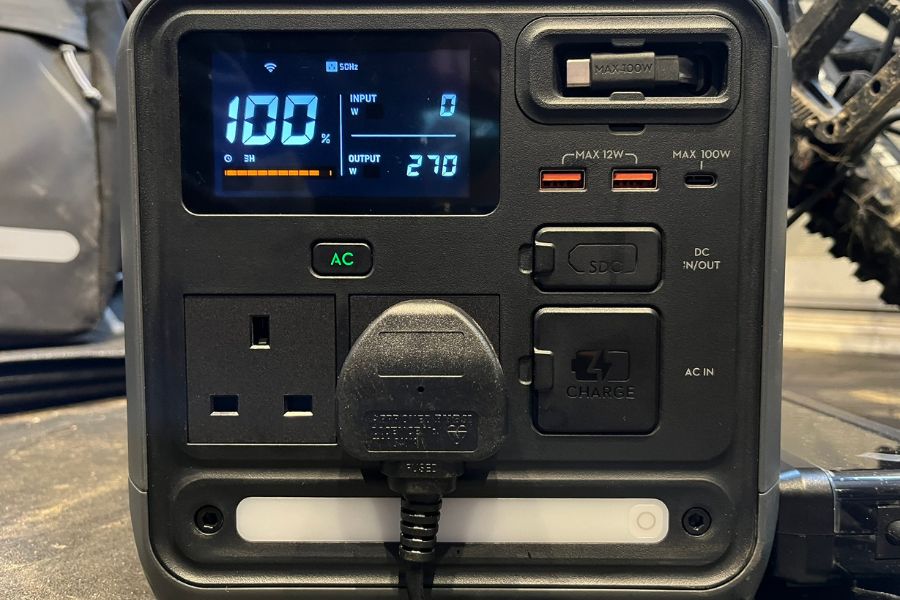
Most riders will charge an eMTB from a portable power station in the same way they charge it at home.
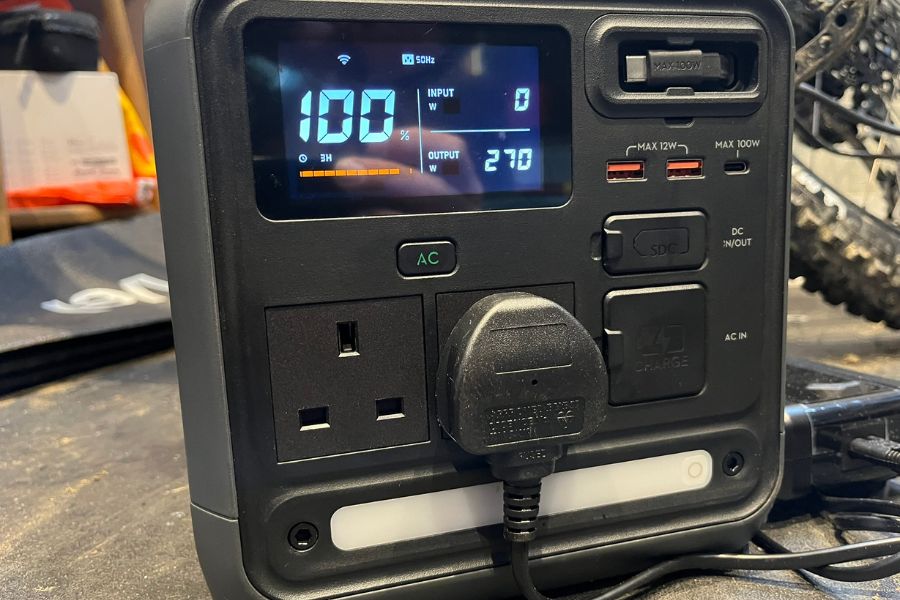
You plug the bike’s normal mains charger into the AC socket on the power station, then connect the charger to the bike battery. The power station acts like a portable plug socket. If you’re unsure, our explainer to eMTB motors and batteries will help you to understand the differences.
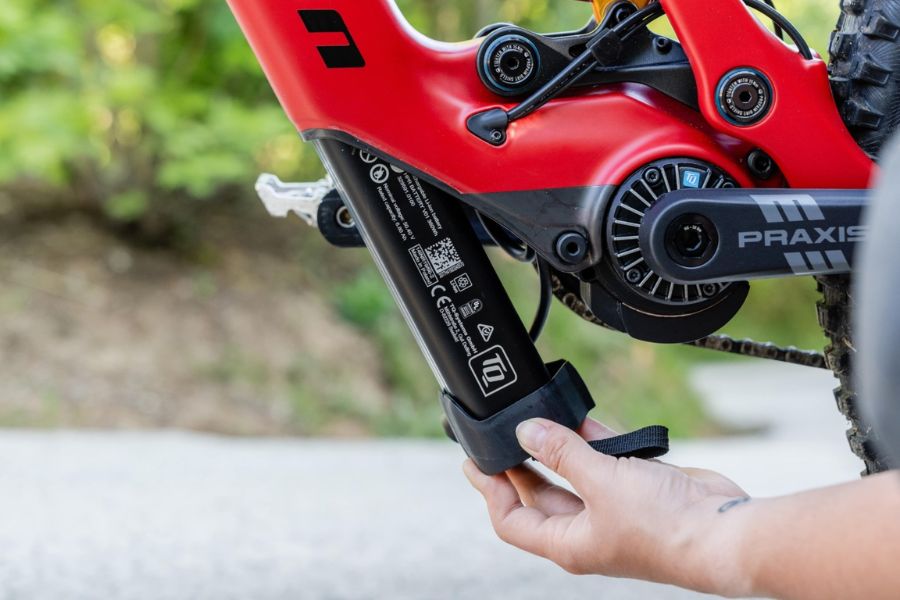
That is the safest and simplest route because you are still using the charger supplied or approved by the bike or battery brand. You should not try to connect a portable power station directly to an eMTB battery unless the bike or battery manufacturer specifically supports that method. eMTB batteries are expensive, high-capacity lithium-ion packs, and the charger is there to manage charging safely.
The key things to check are:
- the capacity of the portable power station, usually shown in Wh
- the capacity of your eMTB battery, also shown in Wh
- the AC output of the power station
- the power draw of your eMTB charger
- whether the power station uses a pure sine wave inverter
- whether the unit can safely run the charger for long enough
Most modern portable power stations from brands such as DJI, EcoFlow, Anker, Jackery and BLUETTI are designed to run AC devices, but it is still worth checking the specifications before buying one specifically for eMTB charging.
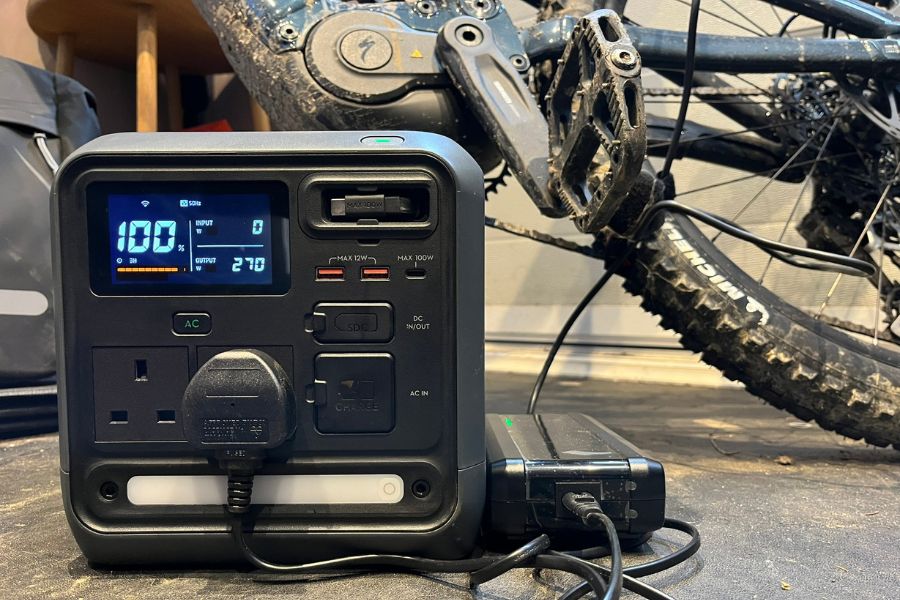
DJI Power 1000 Mini
From £449
How much power does an eMTB battery need?
This is where many people get caught out.
An eMTB battery is usually rated in watt-hours, shortened to Wh. That number tells you roughly how much energy the battery can store. A 500Wh eMTB battery is smaller than a 750Wh or 800Wh battery, and it should take less energy to recharge.
Many modern electric mountain bikes now use batteries in the 600Wh to 800Wh range. Some long-range eMTBs go bigger, and some lightweight eMTBs use smaller internal batteries with optional range extenders.
In theory, if you have a 1,000Wh portable power station and a 500Wh eMTB battery, you might think you can charge it twice.
In reality, you usually cannot.
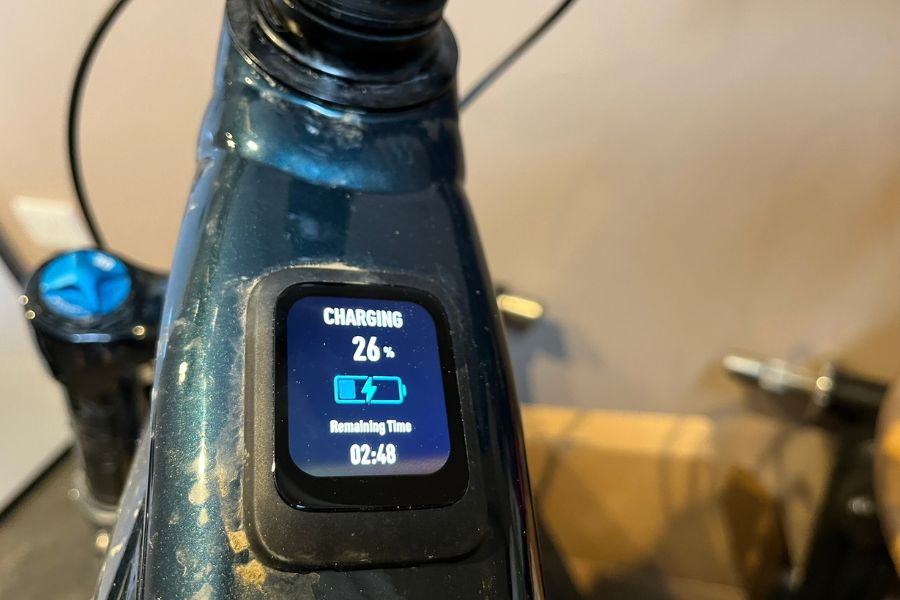
There are losses when converting the power station’s stored DC energy into AC power, then through the eMTB charger and into the bike battery. The charger, battery management system, temperature and charge state can all affect the final result. As a rough working estimate, it is safer to assume you may get around 75–85% of the portable power station’s headline capacity into the bike battery.
That means a 1,000Wh power station might deliver roughly 750–850Wh of useful charging energy in real-world use.
That is still useful, but it changes expectations.
As a rough guide:
| Portable power station size | Practical eMTB charging expectation |
|---|---|
| 300Wh–500Wh | Small top-up only |
| 700Wh–1,000Wh | Useful top-up or close to one charge on smaller batteries |
| 1,000Wh–1,500Wh | Stronger option for one full charge or a large top-up |
| 2,000Wh+ | Better for longer weekends or multiple bikes |
| Expandable system | Best option if you want repeat charging away from mains |
So, if your bike has a 625Wh battery, a 1,000Wh power station could be genuinely useful. If your bike has an 800Wh battery, it may still help, but you should not assume it will give a completely empty battery a guaranteed full charge every time.
Can a 1,000Wh portable power station fully charge an eMTB?
Sometimes, yes. But not always.
A 1,000Wh portable power station is the most tempting size for riders because it sits in the middle ground. It is still portable enough to carry in a car or van, but it has enough capacity to do more than just charge phones and lights. There is another option here as the Ford Ranger PHEV has the option for two outboard plugs to charge as you drive.
For example, a 1,000Wh-class power station may be enough to:
- top up an eMTB battery after a ride
- charge a smaller 500Wh battery close to full
- put a useful amount back into a 625Wh or 750Wh battery
- keep phones, action cameras, GPS units and lights charged
- support a van or camping setup for a short trip
But if your eMTB battery is completely flat after a long ride, especially if it is a 750Wh or 800Wh pack, a 1,000Wh portable power station may not always give you a full charge once losses are taken into account.
This is why portable power works best as part of a realistic riding plan. It is excellent for topping up between rides, recovering some range overnight, or supporting a weekend setup. It is less convincing if you are expecting it to replace proper mains charging for several days of hard eMTB riding.
What size portable power station do eMTB riders need?
For most eMTB riders, I would split it like this.
A small portable power station under 500Wh is useful for phones, lights, cameras, laptops, GPS devices and emergency top-ups. It is not the best choice if your main aim is charging the bike battery.
A 1,000Wh power station is the sensible starting point if you want meaningful eMTB charging. This is the size that starts to make sense for van weekends, camping trips, bike park days or trail-centre riding where you want a proper battery top-up.
A 1,500Wh to 2,000Wh unit makes more sense if you ride a long-range eMTB, use an 800Wh battery, travel with more than one bike, or want to power other camping kit too.
A larger expandable setup is the best choice if you want to build a proper off-grid riding base, but this quickly becomes heavier, more expensive and less convenient.
For most UK riders, the sweet spot is probably a 1,000Wh to 1,500Wh unit. That gives a useful blend of capacity, portability and cost.
What about solar charging?
Solar can help, but it is not a magic answer for eMTB riders in the UK.
A solar panel can put energy back into a portable power station during the day, which is useful if you are camping, parked up at a trail centre, or spending a weekend away. But UK weather, shade, panel angle and short winter days all affect how much energy you actually collect. If you’re having a weekend away with your eMTB and you’re in the market for a long range eMTB, our buyer’s guide to the best long range eMTBs will help you.
Solar is best seen as a way to extend your setup, not as a guaranteed way to fully recharge a large eMTB battery every day.
For summer camping trips, a solar panel could help keep the power station topped up while you ride. For winter riding, forest parking or grey UK weekends, I would treat solar as a bonus rather than the main plan.
If your trip depends on having a full eMTB battery every morning, make sure you have access to mains power, a second bike battery, or a much larger power setup.
Is it safe to charge an eMTB from a portable power station?
It can be safe, provided you use sensible charging habits.
Use the bike’s official charger, plug it into the power station’s AC output, and follow both the bike manufacturer’s and power station manufacturer’s instructions. Do not use damaged chargers, wet cables or improvised adapters. Do not cover the charger while it is running, and avoid charging in a tightly enclosed space where heat cannot escape.
Charging in a van or tent needs extra care. Keep the charger and battery dry, give the charger airflow, and avoid leaving everything buried under kit. If the bike has a removable battery, it may be easier and safer to charge the battery separately in a dry, stable place.
You should also check whether your eMTB charger’s power draw is within the power station’s continuous AC output. Most proper 1,000Wh-class power stations have enough output for a typical e-bike charger, but it is still worth checking. Capacity tells you how much energy the power station stores. Output tells you whether it can actually run the charger.
Those are different things.
When does portable power make most sense for eMTB riders?
Portable power makes most sense when it solves a real riding problem.
It is useful if you are:
- camping near trails
- staying in a van
- riding at a bike park without easy charging
- travelling with cameras, drones, lights and phones
- doing a weekend away with one or two rides
- using a long-range eMTB but still wanting a safety top-up
- keeping emergency power in the car for kit and devices
It makes less sense if you only ride from home, always charge in the garage, or expect a small portable power station to fully recharge multiple large eMTB batteries.
For many riders, the best use is not necessarily charging from empty to full. It is arriving back at the car after a ride, adding a meaningful top-up while you eat or pack, and keeping the rest of your kit alive at the same time.
That is especially useful for eMTB riders who film rides, use GPS navigation, carry rechargeable lights, or travel with family and need phones and devices charged too.
Should you buy a portable power station for eMTB charging?
If you regularly travel to ride, camp, use a van, visit trail centres or spend weekends away with the bike, a portable power station can make a lot of sense.
But buy one with realistic expectations.
For occasional phone, light and camera charging, you do not need a huge unit. For actual eMTB charging, start looking at 1,000Wh and above. For multiple eMTB charges, especially with 750Wh or 800Wh bike batteries, look at larger or expandable systems.
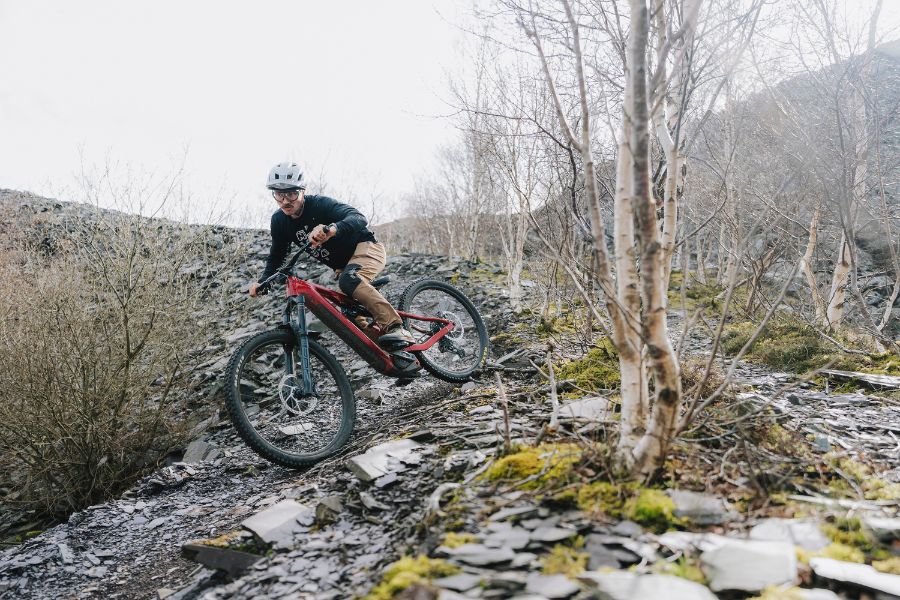
The best portable power station for an eMTB rider is not just the one with the biggest number on the box. It is the one that fits your riding, your vehicle, your storage space, your charging needs and your budget.
A lightweight trail rider who wants to keep cameras and lights charged has different needs from someone running a van-based riding weekend with two full-power eMTBs. if you[‘re unsure on what eMTB to buy or which suits you, our buyer’s guide tot he best eMTBs 2026 should help.
Verdict: can you charge an eMTB from a portable power station?
Yes, you can charge an eMTB from a portable power station, and for the right rider it can be a genuinely useful bit of kit.
The most realistic use is topping up an eMTB battery, supporting a weekend away, charging accessories and giving yourself more flexibility when riding away from home. A 1,000Wh portable power station is a sensible starting point, but it will not always deliver a full charge into a large modern eMTB battery once charging losses are included.
For proper eMTB charging, think in watt-hours, not marketing claims. Check your bike battery size, check the charger draw, check the power station’s AC output, and leave a margin for real-world losses.
Portable power will not replace good ride planning, but it can make eMTB trips easier, especially if your riding life involves vans, camping, trail centres, cameras, family weekends and long days away from a plug socket.