


A portable power station can rescue a riding weekend when the campsite has no hook-up and tomorrow’s route needs more battery than you have left. The useful question is how much energy it can put back into your eMTB, not how many appliances appear in the advertising.
Our shortlist focuses on roughly 1kWh stations from EcoFlow, Anker and Jackery. That is a sensible starting point for one rider making substantial top-ups, although two big batteries or several days away can justify more storage. All three run your normal UK mains charger from an AC socket.
These are researched recommendations based on UK specifications and the needs of riders travelling with their bikes, rather than a back-to-back test. For experience with a different compact station, read our DJI Power 1000 Mini review.
ELECTRIC MTB UK THE SHORTLIST
The shortlist
Find the right pick for your riding. Explore the full product cards to compare the details and retailers.
The best portable power stations for eMTB charging
EcoFlow DELTA 3 — 1024Wh UK power station
A useful starting point for van-based riding weekends, with compatible extra batteries available if your trips grow.

No current price comparison available.
DELTA 3, 1024Wh, UK 230V, station only — not Plus or Classic
Check price on Amazon+ Pros
- Expandable with compatible batteries
- 1800W continuous AC output
- 500W solar input
− Cons
- Cannot fully refill two large eMTB batteries
- Panels and extra batteries cost extra
- Approximately 12.5kg before accessories
Why it makes the shortlist
The DELTA 3 makes most sense if you want one station now and may add storage later. Its 1800W output is above the draw of many bike chargers, but the 1024Wh capacity determines how much riding energy you can replace. Budget for conversion losses and other campsite loads. Use the UK model and your bike manufacturer’s charger.
Key specifications
- Capacity
- 1024Wh
- Continuous AC output
- 1800W
- Battery chemistry
- LFP
- Weight
- Approximately 12.5kg
- Solar input
- Up to 500W
- Expansion
- Compatible EcoFlow extra batteries
- Bike connection
- Original charger via UK AC socket
Anker SOLIX C1000 Gen 2 + 100W solar panel
A 1024Wh station and small solar panel for riders who want to try topping up at camp, with rapid mains charging when a socket is available.

No current price comparison available.
UK SOLIX C1000 Gen 2 with 100W solar panel; not the original C1000
Check price on Amazon+ Pros
- 2000W continuous output
- 100W panel included in this bundle
- Up to 600W solar input with suitable additional panels
− Cons
- 100W panel is slow beside a 1024Wh battery
- Cloud and shade cut solar yield
- Fastest mains charging requires the appropriate app setting
Why it makes the shortlist
Buy this bundle for the station first and the panel second. The 2000W output gives ample charger headroom, but a 100W panel will not replenish a large eMTB battery during a brief lunch stop. It suits leisurely campsite top-ups, especially when you also have mains access. Anker’s claimed 49-minute recharge uses its maximum charging mode; it is not a promise for every socket or setting.
Key specifications
- Capacity
- 1024Wh
- Continuous AC output
- 2000W
- Battery chemistry
- LFP
- Included solar panel
- 100W
- Maximum solar input
- 600W with compatible panels
- Bike connection
- Original charger via UK AC socket
Jackery Explorer 1000 v2 — UK power station
A relatively manageable 10.8kg station for riders carrying their charging kit between the car and campsite.
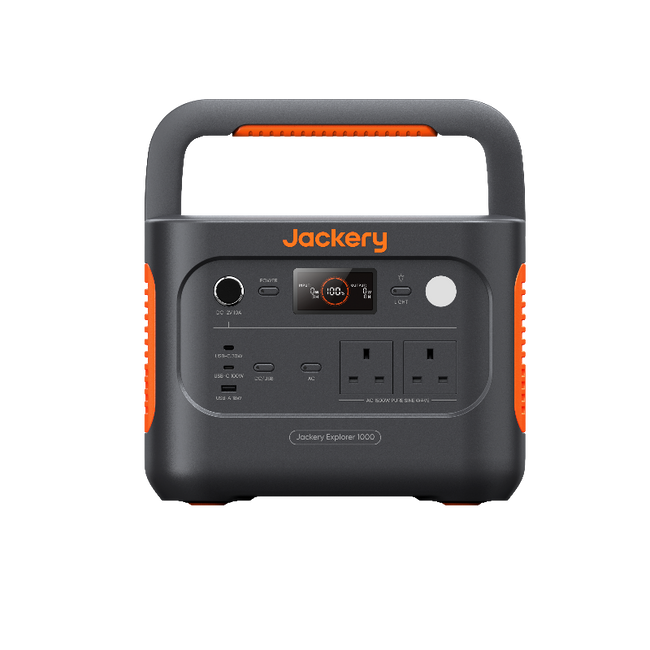
No current price comparison available.
Explorer 1000 v2, UK 230V, 1070Wh, station only
Check price on Amazon+ Pros
- 1070Wh capacity
- 10.8kg claimed weight
- 1500W continuous AC output
− Cons
- Still a sizeable load to carry
- Solar panels cost extra
- Slight capacity advantage over 1024Wh rivals is only about 4.5%
Why it makes the shortlist
The Jackery is the pick here if lifting the station in and out of a vehicle matters more than expansion. Its 1070Wh battery offers a little more stored energy than the two 1024Wh alternatives, but not enough to transform your charging plan. Think one large-bike recharge with losses accounted for, or several partial top-ups, rather than unlimited laps for a group.
Key specifications
- Capacity
- 1070Wh
- Continuous AC output
- 1500W
- Battery chemistry
- LFP
- Weight
- 10.8kg claimed
- UK AC sockets
- Two
- Bike connection
- Original charger via UK AC socket
How big a power station does an eMTB need?
Start with the watt-hour figure on your bike battery. Watt-hours, or Wh, describe stored energy. A 750Wh bike battery holds more energy than a 500Wh battery, while a station marked 1024Wh stores just over 1kWh. Watts, or W, describe power: how quickly energy is supplied or used. A 2000W inverter does not mean a station holds 2000Wh.
You cannot transfer every watt-hour printed on the station into the bike. The station converts battery power into mains AC, your charger converts it back again, and both processes use energy. The station also consumes some power while its AC output is running. Temperature, charging rate and reserve settings affect the result.
For planning, assume around 75–85% of the station’s stated capacity reaches the bike battery. This is an illustrative allowance, not a measured efficiency figure for these models. A 1024Wh station would then supply roughly 770–870Wh to the bike. Leave more margin if the same box is running your fridge, lights or laptop.
A realistic charging budget
Using a conservative 80% planning allowance, a full 1024Wh station provides about 819Wh for bike charging. Refilling a 500Wh battery from empty would use roughly 625Wh from the station; a 750Wh battery would need about 938Wh. A 900Wh battery would need around 1125Wh, so a complete empty-to-full recharge is beyond that budget.
Partial charges are more useful than headline “number of charges” claims. Taking a 750Wh battery from 30% to 90% adds about 450Wh to the bike, costing roughly 563Wh from the station at the same assumed efficiency. Two riders wanting that top-up would exceed a 1024Wh station before powering anything else.
If that sounds like your usual weekend, look at a larger-capacity station or a compatible extra battery. Carrying more storage is less attractive than a small box, but arriving with a neatly packed station that cannot cover the ride is a false economy.
Will it work with Bosch, Shimano or Avinox?
The normal route is straightforward: plug the bike’s original mains charger into the station’s UK AC socket, then connect the charger to the bike as usual. The station supplies mains electricity; the bike-specific charger handles the battery. This avoids trying to match a power station’s DC outlet directly to a proprietary battery connection.
Check the charger’s input rating and the station’s continuous AC rating before buying. Add the draw of both chargers if you plan to charge two bikes together, and include any other connected equipment. Use the standard AC output within its normal rating; boosted or surge figures are not a substitute for continuous output.
A more powerful station will not force your bike to charge faster. The charger and battery determine charging speed. USB-C is useful for a phone, GPS or compatible light, but it is not a replacement for a conventional eMTB charger. Our guide to charging an eMTB from a portable power station explains the setup in more detail.
Solar charging: useful, but do the sums
A panel’s wattage is its rated output under specified conditions, not what it produces throughout a British day. Angle, cloud, shading and daylight hours all matter. A 100W panel producing its full rated output for four hours would supply 400Wh before charging losses. Real output will often be lower, particularly on a winter trip.
That makes the Anker bundle’s 100W panel useful for gradual replenishment, but a poor basis for promising a full bike charge every day. Larger compatible panels can help when you have room to deploy them. Check the station’s permitted solar voltage, current and connectors as well as the headline wattage before combining equipment.
Mains charging before departure remains the dependable baseline. If you want to replenish a station while driving, compare its supported vehicle input and the equipment required. A basic 12V socket and a dedicated alternator charger are very different propositions; do not assume a short drive will refill 1kWh.
What matters at the trailhead?
Weight and handles become important when the car park is a walk from your tent. The Jackery’s claimed 10.8kg is easier to accommodate than many bigger stations, although it is still a heavy extra bag. Include the charger, cables and any solar panel when deciding what you are willing to carry.
Keep the station and charger dry, ventilated and within their stated temperature limits. A campsite setting does not make the electrical sockets weatherproof. Follow the bike maker’s charging instructions, let an overheated battery cool, and never charge a damaged battery. Secure the station for transport and keep cables out of walkways.
Which should you buy?
Choose the EcoFlow DELTA 3 if future expansion is the priority. Choose the Anker SOLIX C1000 Gen 2 bundle if you want a station with a small solar panel included and understand the panel’s limits. Choose the Jackery Explorer 1000 v2 if manageable lifting weight is the more important everyday benefit.
For a pair of long-range eMTBs, calculate the energy you actually need before choosing any of them. A roughly 1kWh station is a handy riding companion, but it is not an unlimited charging point. The right purchase is the one that covers tomorrow’s ride with a margin left over.
